
AltLife Sim
Bountiful Games, LLCSimulation
4.276.00 Reviews
- Version
- 0.21.2
- Installs
- 50.00K
- Age Rating
- Teen
Screenshots
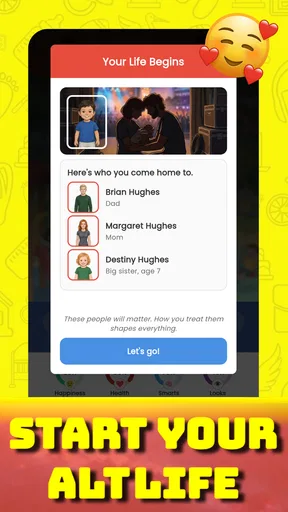

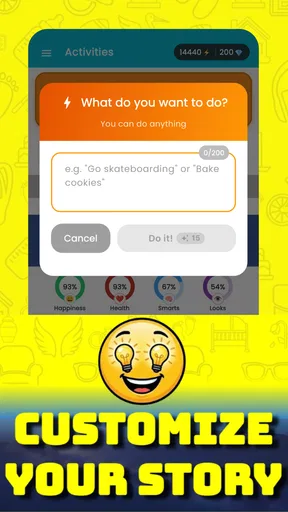
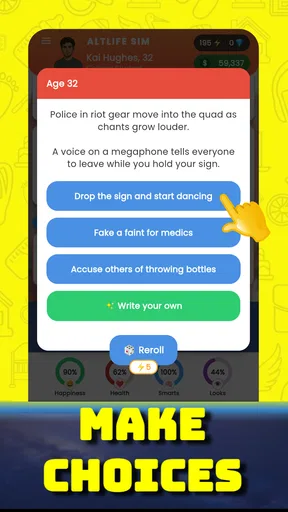

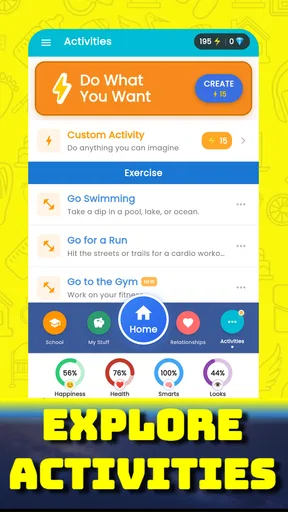


Our Review of AltLife Sim
 Analysis by Appyee
I approached AltLife Sim as a game about agency rather than a traditional life simulator with a fixed route. Its central appeal is simple: I can respond to situations with a choice, or type a decision that reflects the life I want to create. That small change makes each playthrough feel more personal, because I am not only selecting from a menu of outcomes; I am deciding how much control I want to take over the story.
That idea is especially interesting in a simulation game. Many titles in this category ask me to manage money, schedules, buildings, or characters through clearly defined systems. Here, the attraction is the relationship between a life event and my reaction to it. I am less focused on optimizing a city or filling a progress bar and more interested in seeing where a decision leads. In my experience, that makes the game best suited to short, curious sessions where I want to explore possibilities rather than follow a single perfect strategy.
Writing my own direction instead of only selecting an option
The defining capability is the freedom to write a destiny instead of always accepting one of the presented choices. That distinction sounds modest, but it changes how I read every situation. A normal button-based decision can feel like a puzzle with a correct answer. A written decision feels more like a prompt: I have to imagine what my character would actually do, then accept the consequences of that attitude.
I found this most engaging when I stopped trying to make every decision sensible. A cautious life can be entertaining, but so can a deliberately unpredictable one. I could treat a run as a personal experiment, play as someone ambitious, or make choices that create a messy and surprising story. The value is not simply in winning. It is in watching a chain of decisions become a recognizable version of a life.
This also gives the game a useful role as a low-pressure creativity tool. I can use a written choice to test a character idea, imagine an alternative response to a familiar problem, or create a run with a particular theme. That is more flexible than a simulator that only rewards efficient selections. The trade-off is that the experience depends on how much imagination I bring to it. Players who prefer precise goals and transparent mechanics may find this looser format less satisfying.
Because the game is categorized as a simulation title, I expected some room for planning, but I would not approach it like a detailed management spreadsheet. Its strongest identity comes from the narrative freedom around decisions. The written-destiny concept is the feature I would focus on before downloading it, because it determines whether the game feels fresh or vague to you.
What the feature changes during a normal session
In practice, the written-choice concept changes my rhythm. I do not simply tap through events while thinking about something else. I pause to decide whether I want the obvious response, a safer alternative, or a completely personal answer. That extra moment makes individual events feel more connected to the character I am building.
A useful approach is to give each run a simple rule before starting. I might play a character who always protects stability, someone who takes opportunities quickly, or a person who values relationships over progress. The rule gives the free-form decisions a backbone. Without one, it is easy to make random selections and then feel that the resulting life lacks direction.
I also recommend keeping the first run exploratory. Rather than searching for the strongest route immediately, I would try several kinds of responses and observe how the story develops. This is one of the less obvious strengths of the game: the freedom is more enjoyable when treated as a way to learn the shape of the experience, not as a shortcut to a perfect outcome.
Another practical tip is to separate experimentation from commitment. If a decision feels unusual, I would choose it specifically to see what kind of story it creates. On a later run, I could take a more disciplined approach. This makes the game easier to revisit because a new session can have a different purpose instead of repeating the same pattern.
The written input also creates a small mental trade-off. It can make the game feel more expressive, but it may slow down a session compared with a simulator built around rapid tapping. When I only have a few spare minutes, I prefer to make a handful of meaningful decisions rather than rush through a long sequence. That makes it a better fit for focused breaks than for completely passive play.
A realistic everyday use case
Imagine having a short commute or a quiet break after lunch. I would start a new life, choose a broad personality for that run, and make decisions based on that identity instead of trying to maximize every result. If an event presents a familiar dilemma, I can use the moment to explore how a different version of me might respond. The session becomes a compact thought experiment rather than another endless game demanding constant attention.
That scenario also shows why the game can work well for people who enjoy interactive stories but want more personal input. I am not just watching a character move through scripted scenes. I am shaping the tone of the run through repeated choices. A cautious player can create a steady story, while an impulsive player can deliberately introduce uncertainty.
For parents considering it for a younger player, the Teen content rating matters. I would not treat it as a children’s game simply because the controls are approachable. A teenager who enjoys decision-based simulations may understand its appeal, while younger children may need guidance about the themes and situations they encounter. Adults should make that judgment based on the player, rather than assuming that a life simulator is automatically suitable for everyone.
The game is free to start, which makes trying this central idea relatively easy. At the same time, in-app purchases range from $1.99 to $99.99 per item, so I would check the purchase flow carefully and use device controls if someone else will be playing. The free entry point is convenient, but the broad purchase range means I would not hand over an unrestricted payment method without thinking about it.
Where the freedom is genuinely useful
The biggest benefit appears when I want a game that can reflect different moods. On one evening, I might play a careful, responsible character. On another, I might create a run built around risk and unusual decisions. The same basic capability supports both approaches, which gives the game more replay value than a fixed sequence of choices.
It is also useful for players who dislike being told that there is only one sensible way to proceed. In many simulation games, success depends on learning an optimal order of actions. Here, I can value the story itself. A disappointing result is not necessarily a failure if it produces a more interesting life to follow.
One advanced way to use the system is to compare two runs that begin with the same intention but diverge after one important decision. I can keep the early approach consistent, then deliberately choose different responses later. This makes the consequences easier to appreciate and turns replaying into a comparison exercise rather than a reset button.
I would also use written decisions to create a personal narrative log outside the game if I wanted to remember particularly unusual runs. The point is not to record every event. Instead, I would note the character’s guiding rule and the moment where the story changed direction. That habit helps me notice patterns in my own play and makes the open-ended design feel more structured.
The trade-offs behind an open-ended simulator
The same freedom that makes the game distinctive can make it less predictable. If you want clearly explained systems, deep resource management, or a strong competitive target, this may not be the right choice. A management-focused alternative will usually be better for someone who enjoys optimizing budgets, production chains, or long-term statistics.
It may also be less satisfying for players who prefer polished, heavily scripted storytelling. A scripted adventure can deliver carefully timed scenes and a strong authorial voice. AltLife Sim appeals more to the player who wants to participate in forming the direction of a life, even if that means the experience feels less controlled.
There is a second trade-off in replayability. The ability to create different destinies encourages experimentation, but replay value depends on whether the situations and outcomes continue to feel meaningful to you. If you enjoy inventing character rules and testing different responses, the format can stay engaging. If you mainly want new visual content or a large collection of handcrafted missions, another genre may offer more variety.
I would not recommend approaching it with the expectation that every written decision will produce a perfectly tailored story. The appeal is the feeling of authorship, not the promise that every imagined outcome will unfold exactly as I picture it. Keeping that expectation realistic prevents disappointment and makes the game’s flexible structure easier to appreciate.
The current version is 0.21.2, and the game comes from Bountiful Games, LLC. Those details are useful when checking compatibility and identifying the exact release before installing. It supports Android 7.0 and later, so many older compatible devices can potentially run it, though the actual experience will still depend on the phone or tablet.
Who gets the most from the concept
I think the best audience is someone who enjoys choice-driven simulation, interactive storytelling, and replaying a scenario with a different mindset. If you like asking “what would happen if I did this instead?” the written-destiny feature gives you a reason to return. It is particularly appealing to players who want a personal story rather than a universal high score.
It is also a good match for people who enjoy lightweight games in which imagination does some of the work. You do not need to master a complicated control scheme to begin, but you do need to be willing to make decisions that are not always obviously optimal. The game rewards curiosity more than reflexes.
I would suggest skipping it if your priority is a detailed economic simulator, a competitive leaderboard, or a tightly authored adventure. Those preferences point toward more specialized alternatives. I would also hesitate to recommend it to anyone who dislikes uncertain outcomes or wants every mechanic explained before making a move. The open-ended premise is the reason to play, but it is also the source of the game’s friction.
The public response gives the game a 4.2 average from around 452 ratings, with roughly 76 written reviews and over 50 thousand installs. I read those figures as signs of a real audience rather than proof that it will suit everyone. The more important question is whether you enjoy the specific kind of freedom it offers.
My recommendation after testing the idea
What stayed with me was not a particular result but the change in attitude the game encourages. Instead of asking only which button gives the best outcome, I started asking what kind of life I was trying to create. That is a meaningful distinction, and it gives the simulator a personality of its own.
I would download it for free if I wanted an experimental life game that fits into short sessions and lets me shape a run through personal decisions. I would begin with a simple character rule, try one careful playthrough, and then deliberately make a contrasting run. That approach reveals the value of the system much faster than blindly tapping through events.
My final view is positive but specific: this is not the best choice for every simulation fan, and it should not be judged as though it were a conventional management game. Its strongest feature is the invitation to write your own direction, and its success depends on whether that freedom feels exciting rather than imprecise. For me, it works when I want a small interactive experiment with room for surprise. If you enjoy shaping stories through decisions instead of chasing one perfect solution, this is worth trying.
Verdict
Strengths of AltLife Sim
- Deep life-simulation choices create varied playthroughs.
- Simple menus make the game easy to learn.
- Many career and relationship paths encourage replayability.
- Random events add surprises to otherwise routine decisions.
- Offline play lets you manage your virtual life without internet.
Limitations of AltLife Sim
- Progress can feel repetitive after several simulated lifetimes.
- Some choices have limited explanation before you commit.
- Ads or in-app purchases may interrupt the free experience.
- Long-term goals may take considerable time to complete.
- The interface can feel text-heavy for players wanting visual gameplay.
Similar Picks in This Category
View All
Truckers of Europe 3
Wanda Software4.3

Town Building Life Simulator
XGame Global4.2

Fidget Toys Trading・Pop It 3D
Freeplay Inc4.7

Sculpt People
CrazyLabs LTD4.4

Scary Teacher 3D
Z & K Games4.2

Hair Tattoo: Barber Shop Game
CASUAL AZUR GAMES4.3
Frequently Asked Questions
What is AltLife Sim?
AltLife Sim is a text-based life simulation game in which you guide a virtual character through different stages of life. You can make choices about education, careers, relationships, finances, health, and personal goals. Each decision can influence future events, allowing you to experience different outcomes and replay the game with a new strategy or lifestyle.
How does gameplay work in AltLife Sim?
Gameplay is mainly based on reading situations and selecting actions for your character. You typically progress through life year by year, managing statistics such as money, happiness, health, and relationships. The game presents opportunities and unexpected events, so choices that seem helpful in the short term may create different consequences later in the character’s life.
Is AltLife Sim free to download and play?
AltLife Sim can generally be downloaded without an upfront purchase, but availability of optional in-app purchases, advertisements, or premium features may depend on the version and platform. Before downloading, check the current store listing for pricing details. Players should also review whether extra content is necessary, since the core life-simulation experience may be accessible without spending money.
Can I play AltLife Sim offline?
AltLife Sim may support playing many of its life-simulation features without a continuous internet connection, which is useful when traveling or using mobile data sparingly. However, some functions—such as advertisements, purchases, updates, analytics, or online services—could require connectivity. It is best to launch the game once while online and review its behavior before relying on offline access.
Is AltLife Sim suitable for all ages?
AltLife Sim is designed for players who enjoy decision-based simulations, but it may include mature themes connected with real-life situations, relationships, money, health, crime, or other serious choices. The exact content and rating can vary between Android and iOS versions. Parents should check the official age rating, permissions, and store description before allowing younger users to download it.
Play our best games!


